Why should you learn the colors in French?
Learning colors in French offers numerous advantages – both for beginners and advanced learners who want to improve their language skills. Here are three reasons why it’s worthwhile:

Language
Colors are more than just words – they connect people, evoke memories and give us a better understanding of the world. But how do you describe the vibrant red of a poppy field in Provence or the calming blue of the sea in French? This is where our adventure into the world of colors and their meanings begins. In this blog article, we’ll explore the basics of French color vocabulary.
Learning colors in French offers numerous advantages – both for beginners and advanced learners who want to improve their language skills. Here are three reasons why it’s worthwhile:
Colors are among the essential words of a language. They are used in many everyday situations – whether to describe clothing, objects or impressions. Those who master colors can express themselves directly, precisely and comprehensibly.
Colors have their own symbolism in every culture. In French, for example, there are numerous idioms and expressions associated with colors, such as “voir la vie en rose” (“to see things through rose-colored glasses”) or “être vert de rage” (“to be green with rage”). The phrases are a window into the French mentality and way of thinking.
Whether shopping, fashion, cooking or traveling – knowing the colors helps in many practical situations. In France, we encounter colors everywhere: at markets full of fresh fruit or in the elegant boutiques of Paris.
Colors are an integral part of the French language – they bring descriptions to life, shape idioms and reflect cultural details. Whether you want to describe the bright tones of a Parisian market or name elegant color combinations in the fashion world, the vocabulary of colors opens the door to a colorful variety of expressions. Let’s first take a look at how to say “color” correctly.
| English | French |
|---|---|
| The color yellow | La couleur jaune |
| The green colors | Les couleurs verts |
| English | French |
|---|---|
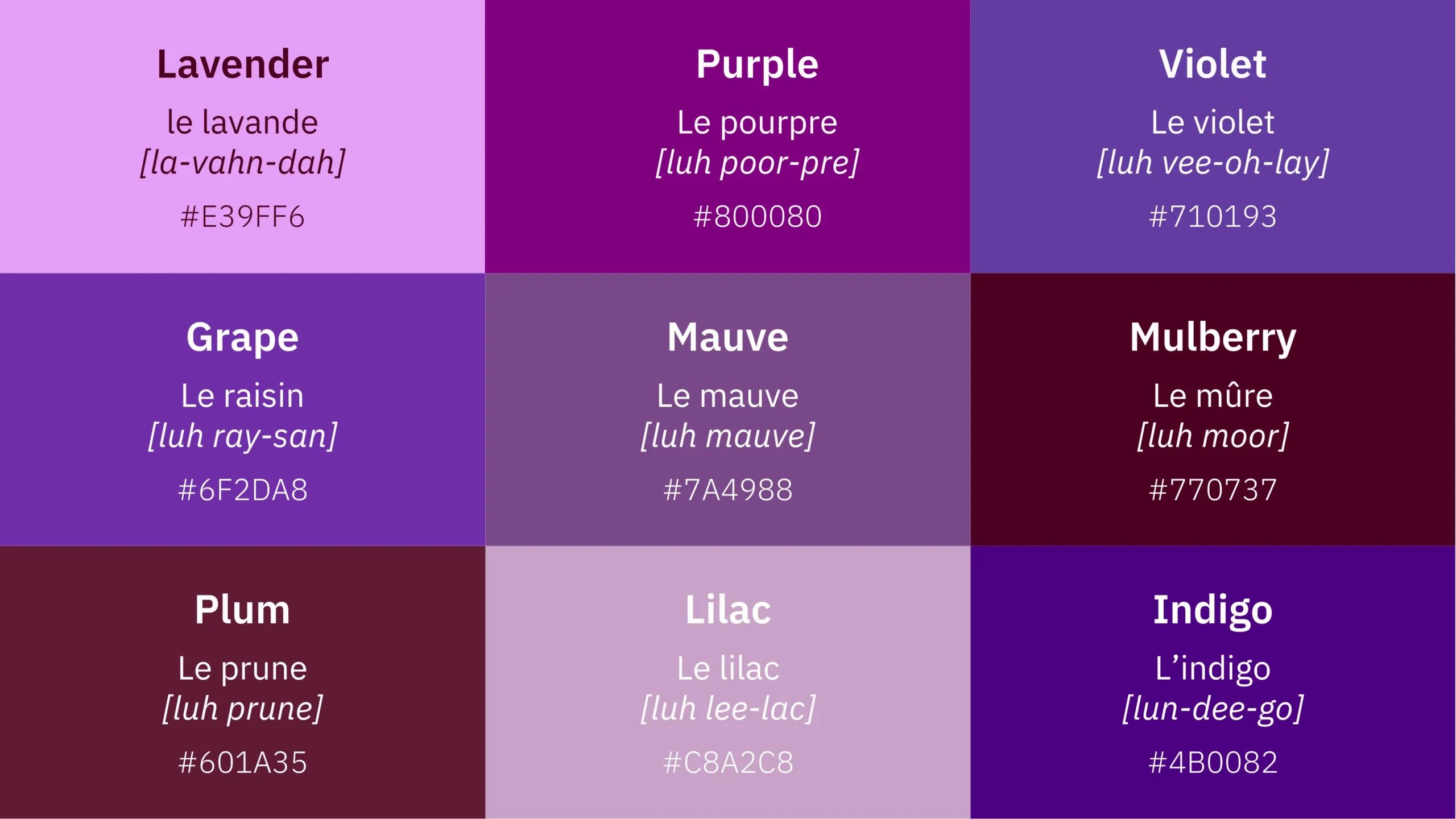
| Lavender | Le lavande |
| Purple | Le pourpre |
| Violet | Le violet |
| Grape | Le raisin |
| Mauve | Le mauve |
| Mulberry | Le mûre |
| Plum | Le prune |
| Indigo | L’indigo |
| Lilac | Le lilac |
| English | French |
|---|---|
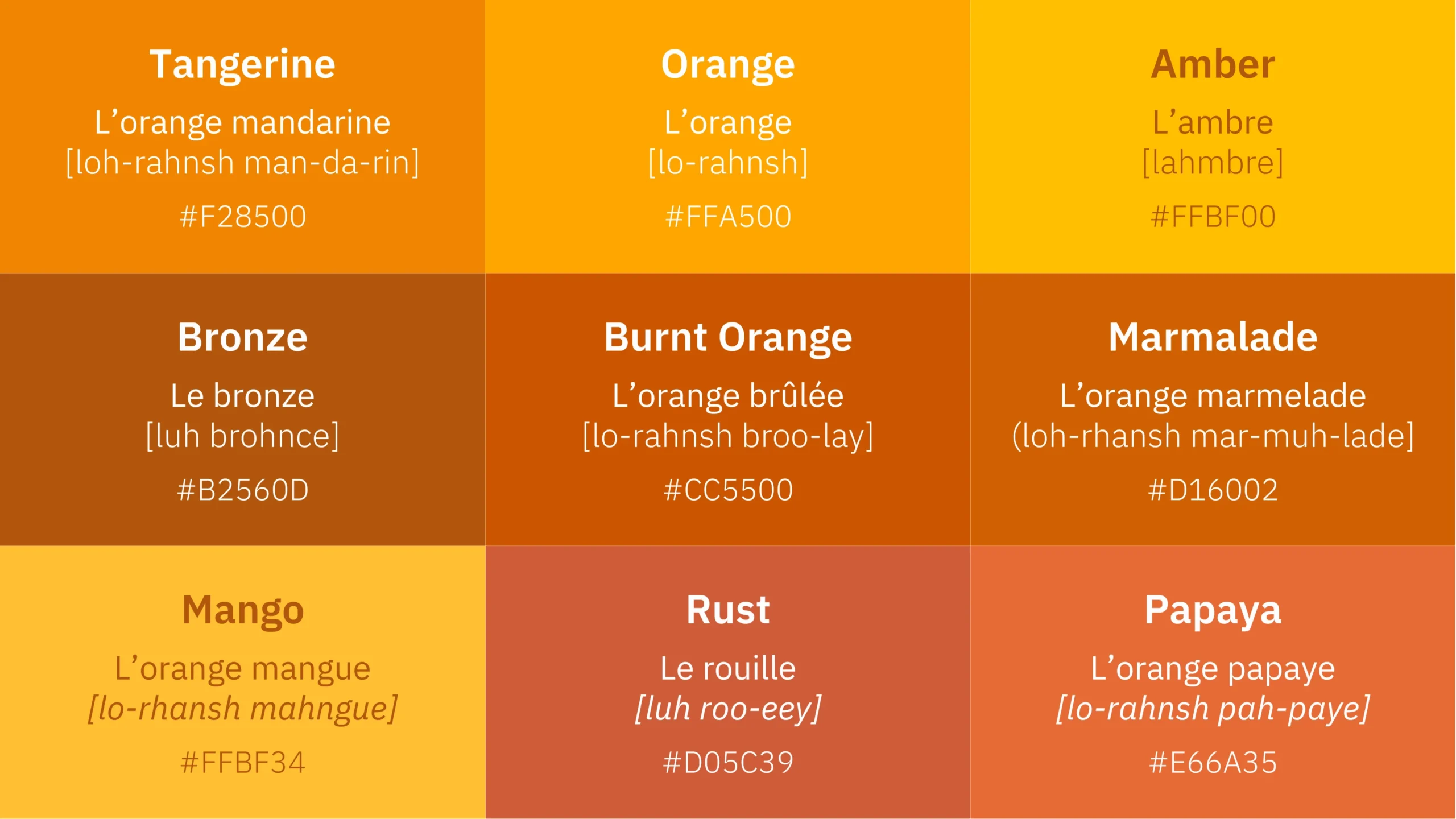
| Tangerine | L’orange mandarine |
| Orange | L’orange |
| Amber | L’ambre |
| Bronze | Le bronze |
| Burnt Orange | L’orange brûlée |
| Marmalade | L’orange marmelade |
| Mango | L’orange mangue |
| Rust | Le rouille |
| Papaya | L’orange papaye |
| English | French |
|---|---|
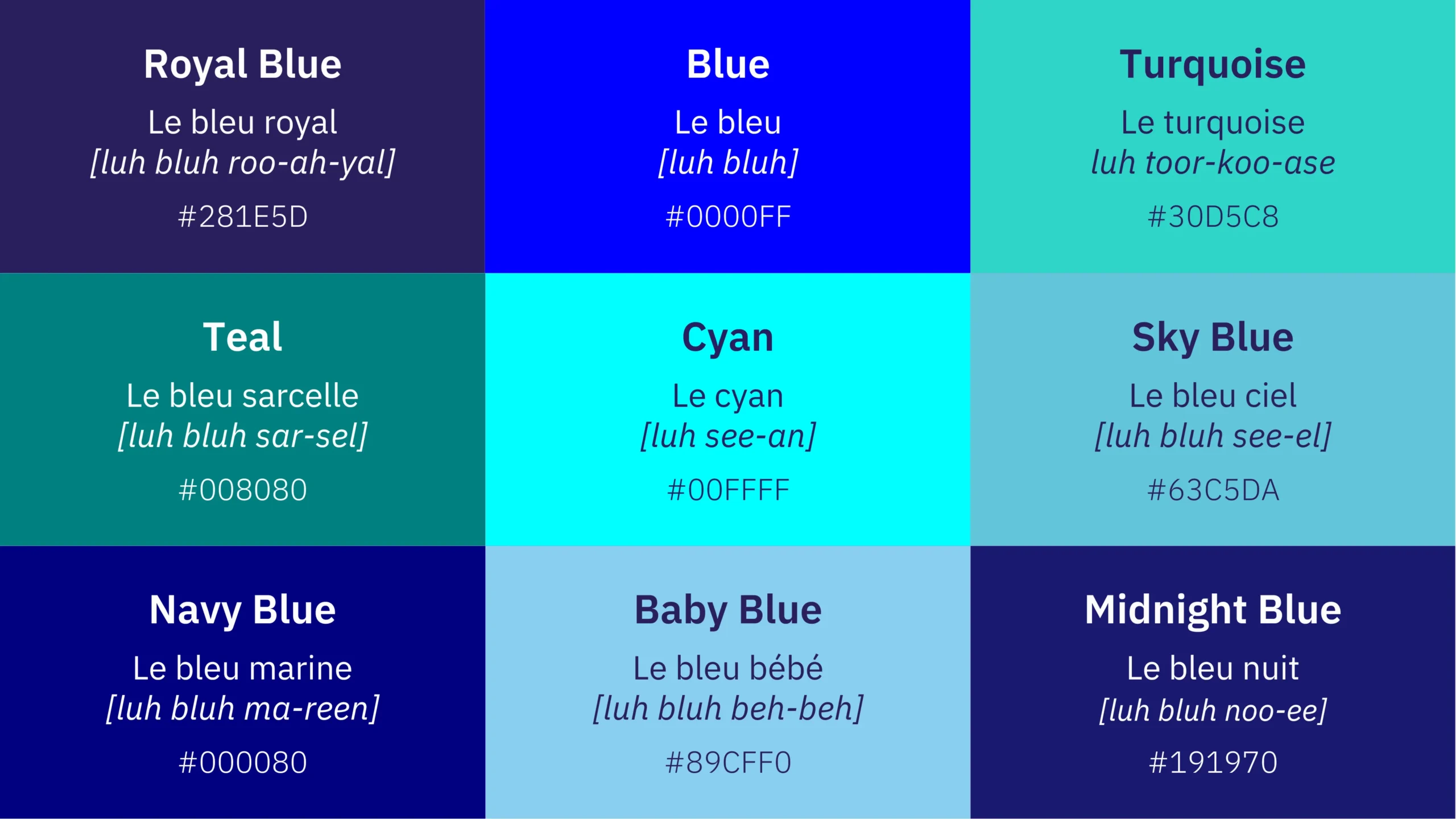
| Royal Blue | Le bleu royal |
| Blue | Le bleu |
| Turquoise | Le turquoise |
| Teal | Le bleu sarcelle |
| Cyan | Le cyan |
| Sky Blue | Le bleu ciel |
| Navy Blue | Le bleu marine |
| Baby Blue | Le bleu bébé |
| Midnight Blue | Le bleu nuit |
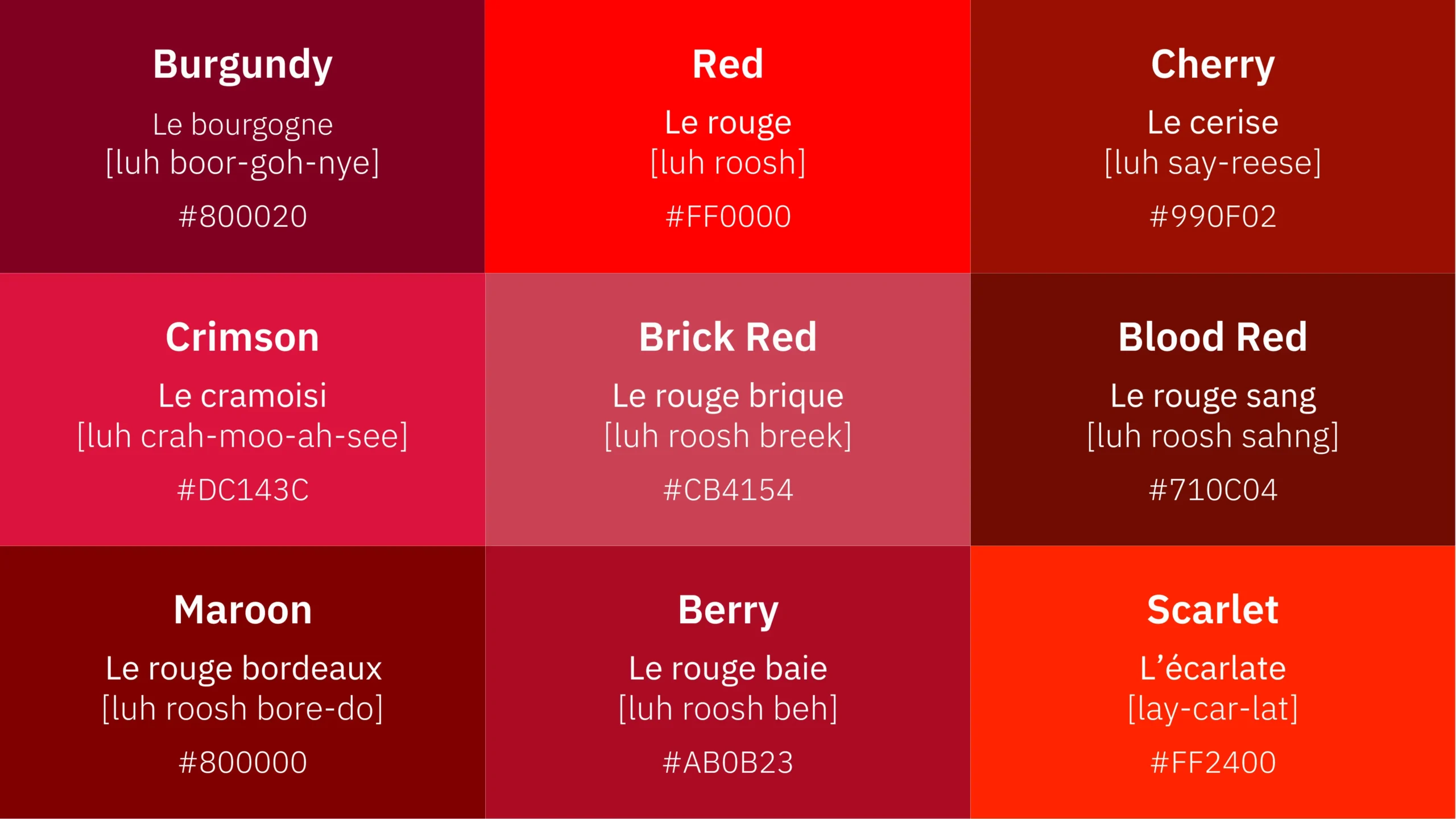
| English | French |
|---|---|
| Burgundy | Le bourgogne |
| Red | Le rouge |
| Cherry | Le cerise |
| Crimson | Le cramoisi |
| Brick Red | Le rouge brique |
| Blood Red | Le rouge sang |
| Maroon | Le rouge bordeaux |
| Berry | Le rouge baie |
| Scarlet | L’écarlate |
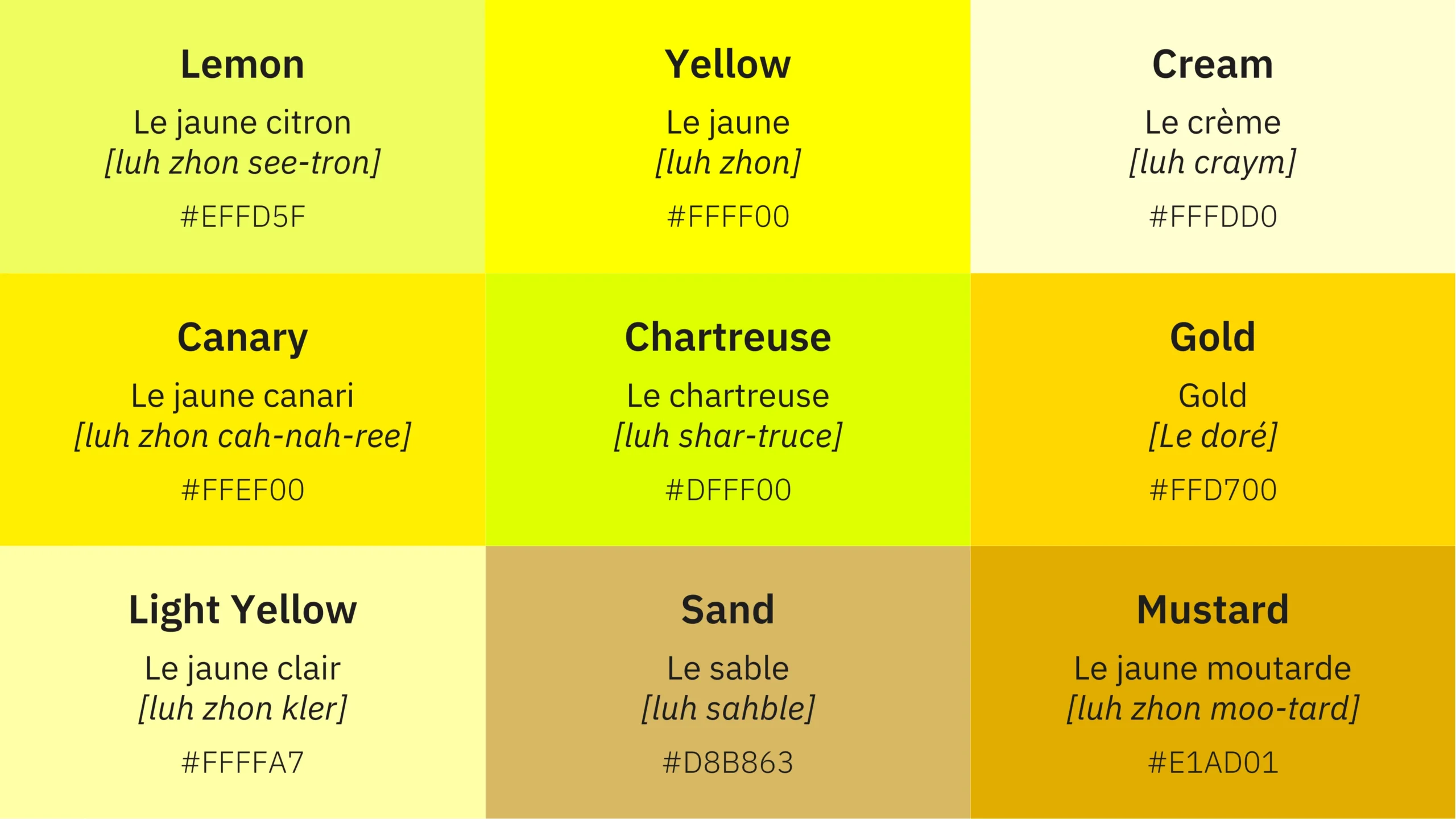
| English | French |
|---|---|
| Lemon | Le jaune citron |
| Yellow | Le jaune |
| Cream | Le crème |
| Canary | Le jaune canari |
| Chartreuse | Le chartreuse |
| Gold | Le doré |
| Light Yellow | Le jaune clair |
| Sand | Le sable |
| Mustard | Le jaune moutarde |
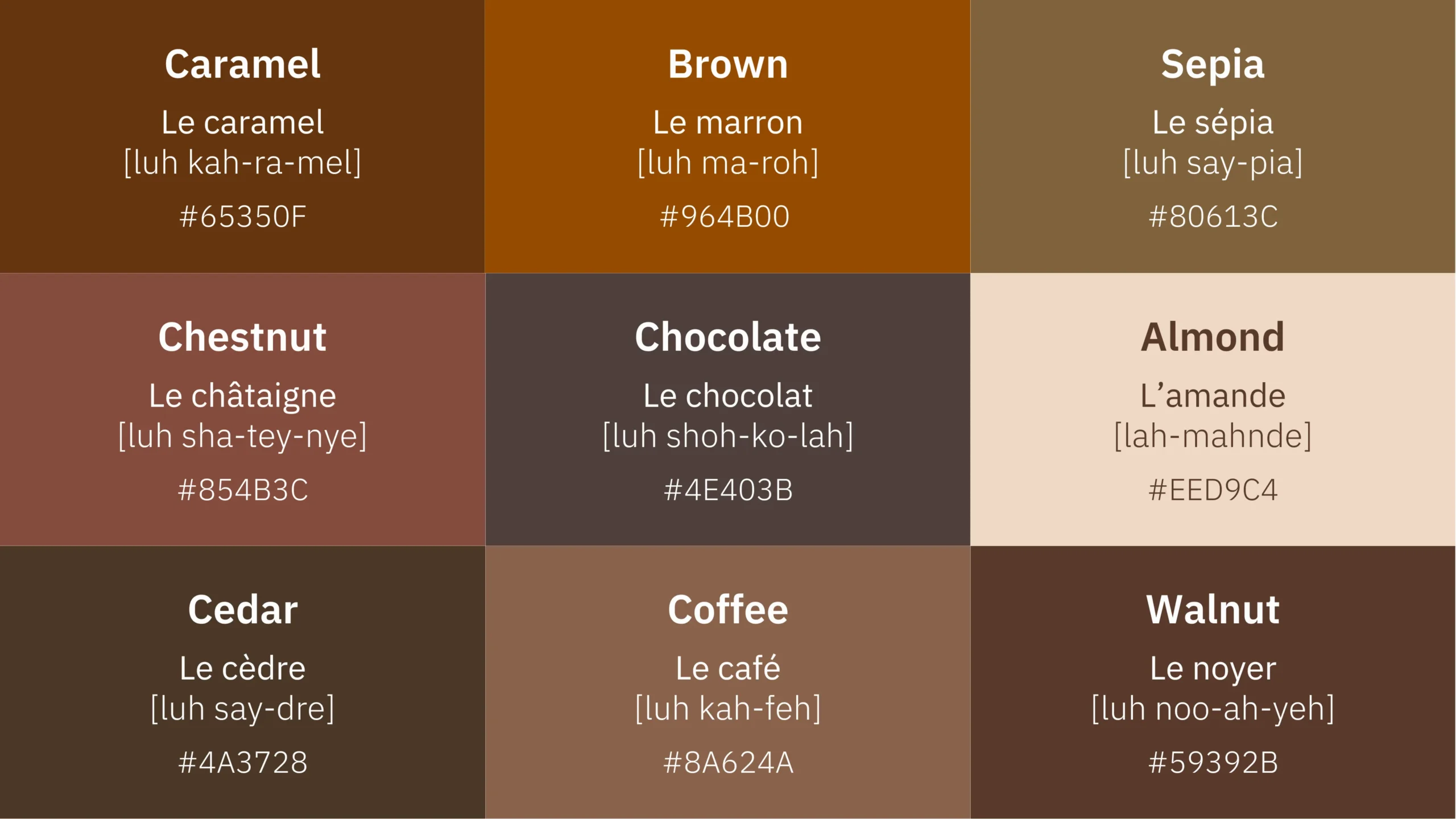
| English | French |
|---|---|
| Caramel | Le caramel |
| Brown | Le marron |
| Sepia | Le sépia |
| Chestnut | Le châtaigne |
| Chocolate | L’amande |
| Almond | L’amande |
| Cedar | Le cèdre |
| Coffee | Le café |
| Walnut | Le noyer |
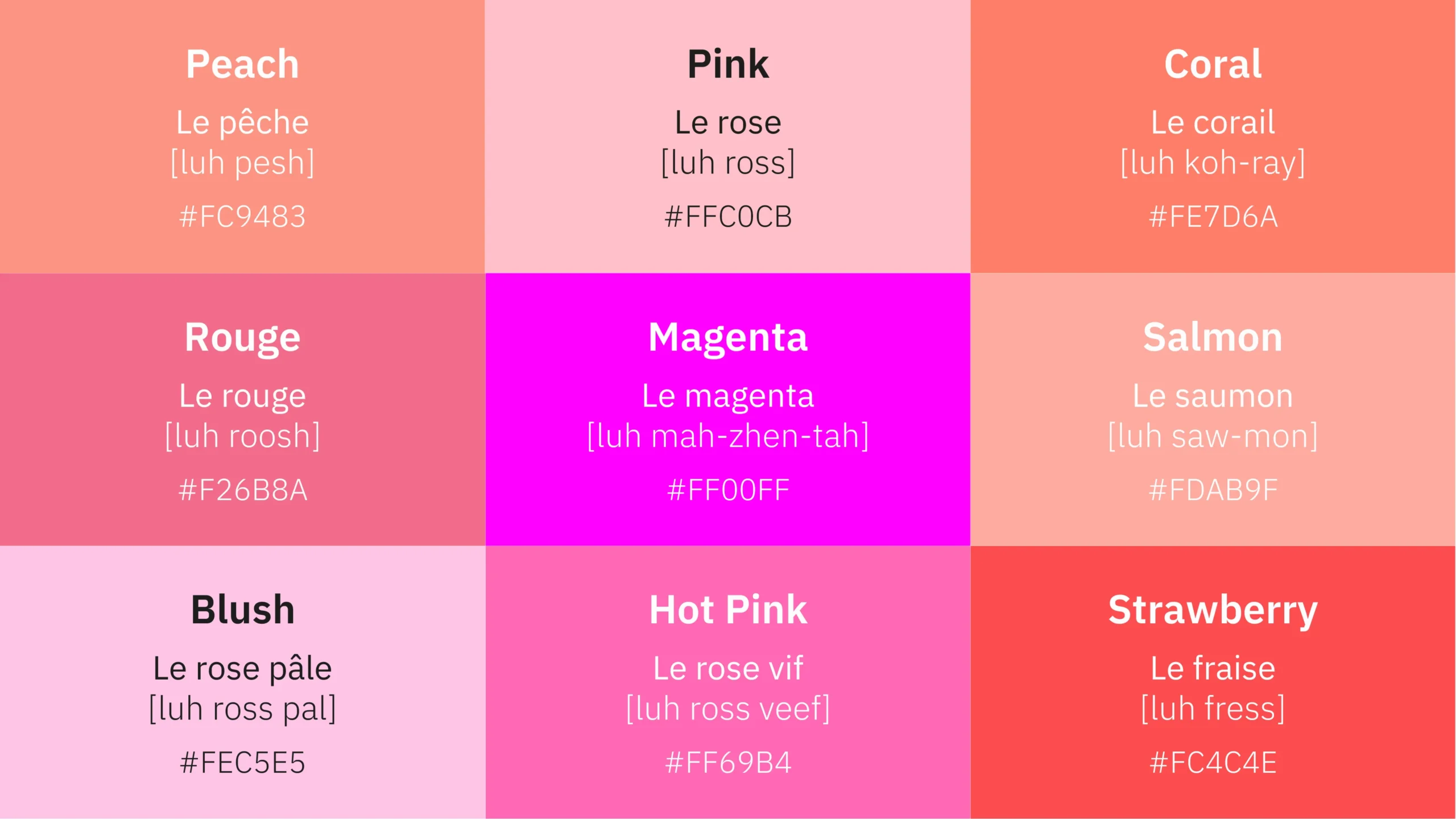
| English | French |
|---|---|
| Peach | Le pêche |
| Pink | Le rose |
| Coral | Le corail |
| Rouge | Le rouge |
| Magenta | Le magenta |
| Salmon | Le saumon |
| Blush | Le rose pâle |
| Hot Pink | Le rose vif |
| Strawberry | Le fraise |
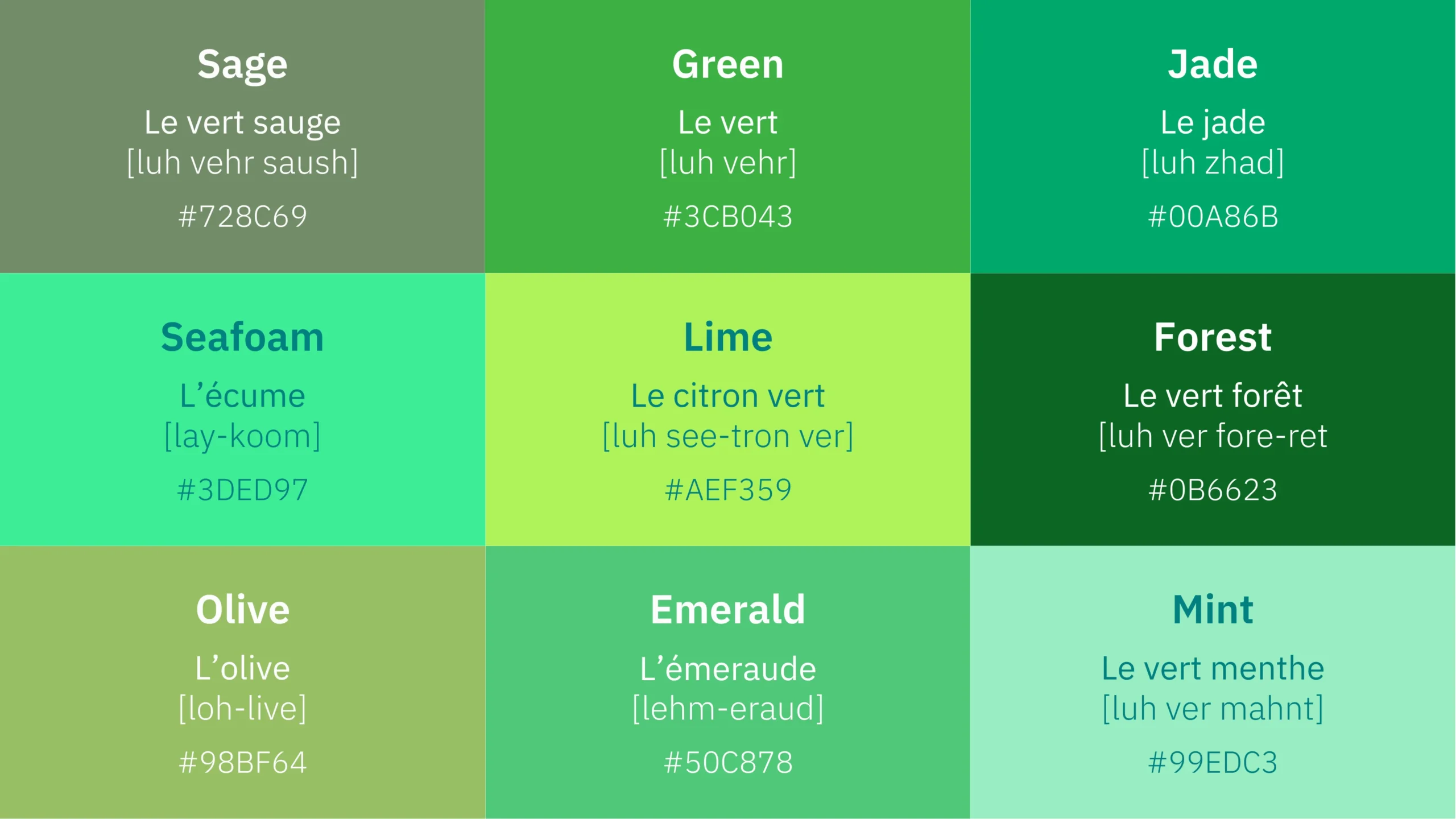
| English | French |
|---|---|
| Sage | Le vert sauge |
| Green | Le vert |
| Jade | Le jade |
| Seafoam | L’écume |
| Lime | Le citron vert |
| Forest | Le vert forêt |
| Olive | L’olive |
| Emerald | L’émeraude |
| Mint | Le vert menthe |
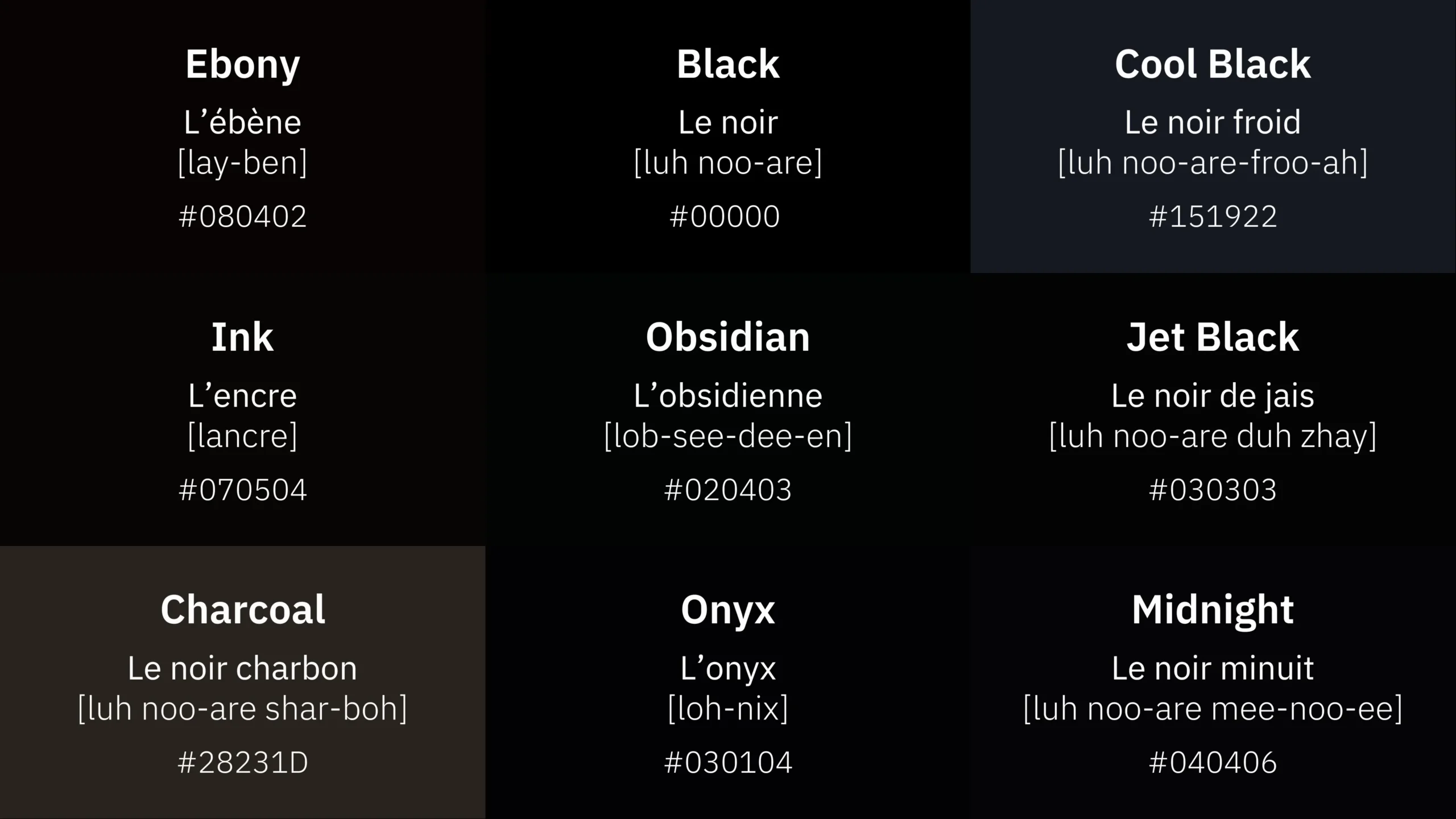
| English | French |
|---|---|
| Sage | Le vert sauge |
| Ebony | L’ébène |
| Black | Le noir |
| Cool Black | Le noir froid |
| Ink | L’encre |
| Obsidian | L’obsidienne |
| Jet Black | Le noir de jais |
| Charcoal | Le noir charbon |
| Onyx | L’onyx |
| Midnight | Le noir minuit |
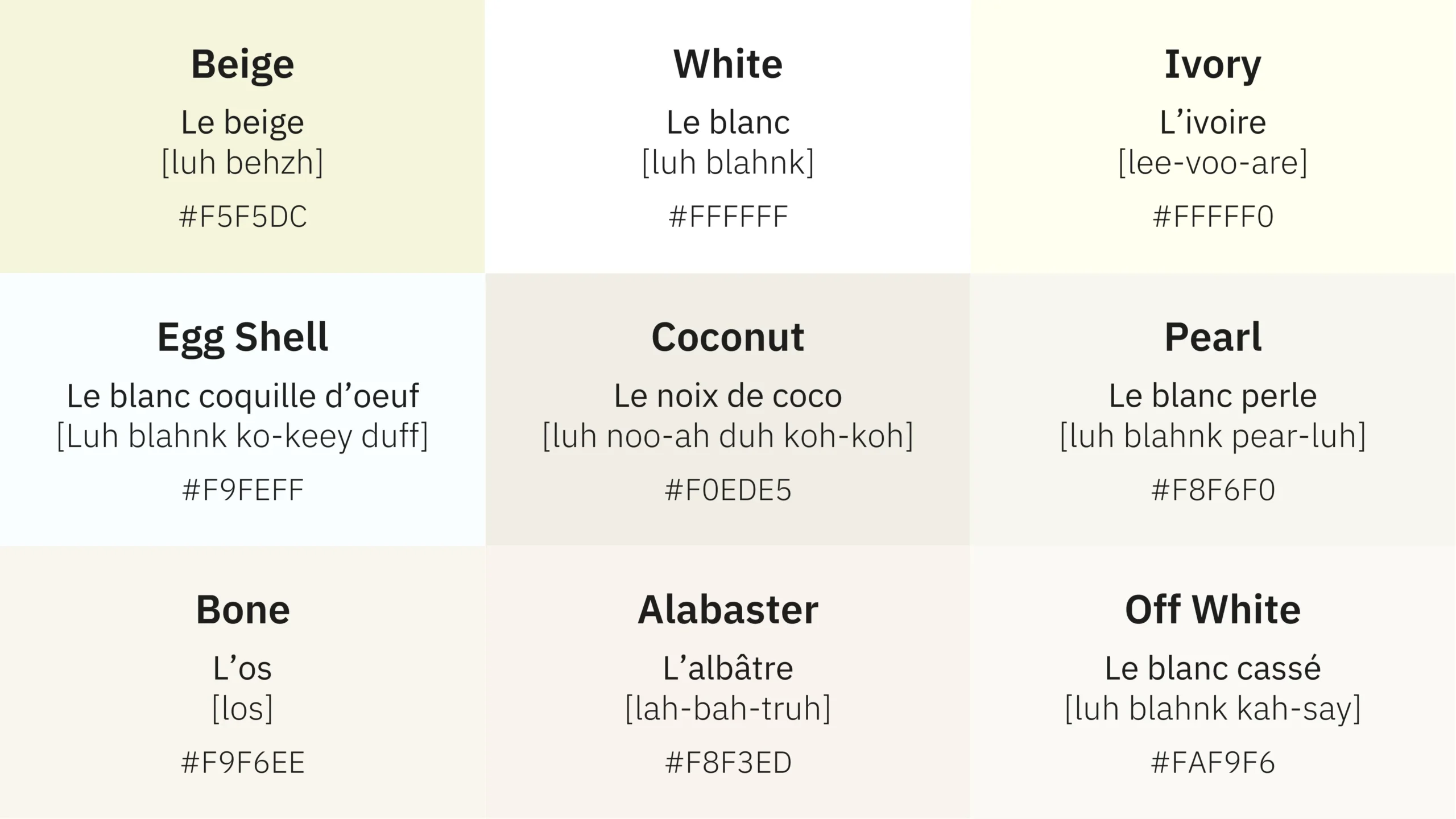
| English | French |
|---|---|
| Beige | Le beige |
| White | Le blanc |
| Ivory | L’ivoire |
| Eggshell | Le blanc coquille d’oeuf |
| Coconut | Le noix de coco |
| Pearl | Le blanc perle |
| Bone | L’os |
| Alabaster | L’albâtre |
| Off White | Le blanc cassé |
In French, color adjectives must be adapted to the noun they describe – both in gender (masculine or feminine) and in number (singular or plural). For example: “une robe rouge” (a red dress) vs. “des robes rouges” (red dresses). Some color names (such as orange or marron) remain unchanged regardless of whether they are masculine, feminine, singular or plural.
Good to know: Colors themselves are adjectives and have no fixed gender. They always adapt to the noun they describe. Example: “un pull bleu” (a blue sweater) vs. “une chemise bleue” (a blue blouse).
| French idiom | Meaning |
|---|---|
| Dans le rouge | In danger/in the red |
| Être rouge comme une tomate | To be extremely sunburnt |
| Être sur la liste rouge | To be blacklisted |
| Être rouge de colère | To be so angry you turn red |
| Un rire jaune | A sarcastic or forced laugh |
| Donner le feu vert | To greenlight (something) |
| Être vert de la jalousie | To be green with envy |
| Un numéro vert | A toll-free number |
| Un examen blanc | A mock test |
| Une nuit blanche | A sleepless night or an all-nighter |
| Un film noir | A crime movie |
| Broyer du noir | To feel sad |
| Être noir de monde | When a place is extremely crowded |
| Travail au noir | To work under the table |
| Être gris/grise | To be tipsy |
| La nuit, tous les chats sont gris | At the end of the day, everyone’s the same |
| Un mariage gris | A green card marriage |
| À l’eau de rose | Used to describe something that is overly sentimental or cheesy |
| Voir la vie en rose | To see life through rose-colored glasses |
Learning colors in French is much more than just memorizing words – it opens up access to a living language and its cultural diversity. Colors are omnipresent: they enrich descriptions, shape idioms and reflect the French way of life.
So whether in everyday conversations or simply for the fun of discovering new expressions, the color vocabulary is a colorful and rewarding step on the way to mastering the language. With a little practice and curiosity, you’ll soon realize how colorful and fascinating the French language is. You can test your knowledge directly in a French course.